
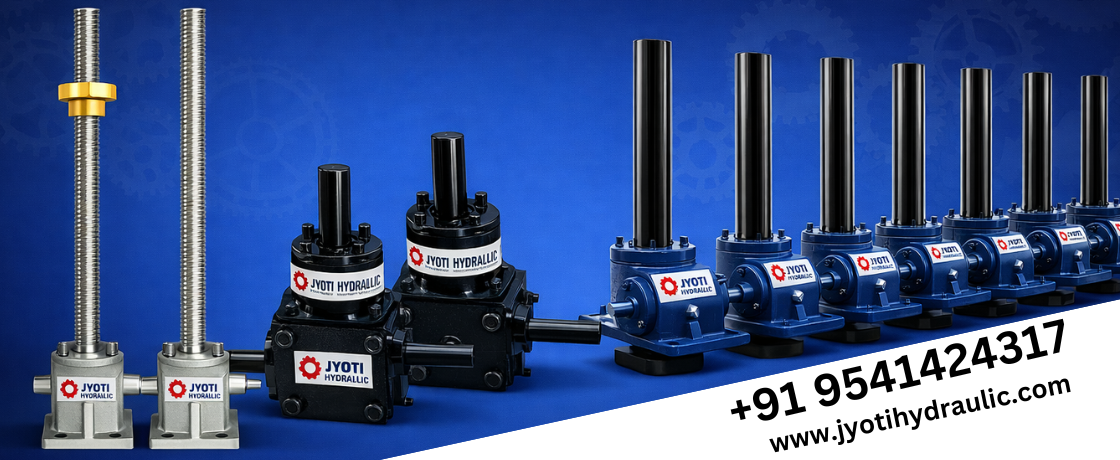
Jyoti Hydraulic has spent decades engineering heavy-duty lifting solutions where safety is not an add-on—it is a design foundation. In industrial environments where loads, people, and processes intersect, even a small miscalculation can result in costly downtime or serious injury. That is why every Worm Gear Screw Jack used in critical applications must be evaluated through structured risk-assessment frameworks like ISO 14121, which defines how machinery hazards are identified, calculated, and controlled at the design stage.
This blog explains why ISO 14121 safety calculations are essential for worm-driven screw jack systems, how they influence engineering decisions, and what B2B buyers, OEMs, and EPC contractors should look for when sourcing compliant lifting equipment from trusted manufacturers in India and global markets.
Why ISO 14121 Matters
ISO 14121 ensures worm gear screw jacks are designed after systematic hazard identification, risk estimation, and risk reduction. It minimizes failure, overload, and human-machine interaction risks by integrating safety calculations into mechanical design, materials, and operating limits—making equipment safer, compliant, and more reliable.
What Is ISO 14121 and Why Is It Critical for Screw Jacks?
ISO 14121 (now aligned with ISO 12100 methodology) is an international standard for machinery risk assessment. It defines a structured process to:
-
Identify potential hazards
-
Estimate the severity and probability of harm
-
Evaluate risk acceptability
-
Apply design-level risk reduction measures
For worm-driven screw jacks, hazards may include load drop, mechanical failure, self-locking loss, misalignment, or operator misuse. ISO 14121 ensures these risks are addressed before manufacturing—not after installation.
ISO 14121 is a machinery safety standard that guides engineers to calculate and reduce risks during equipment design.
How Do Worm Gear Screw Jacks Work? (Step-by-Step)
-
Input Torque Application – Motor or hand wheel applies rotational force to the worm shaft
-
Worm–Wheel Engagement – The worm gear meshes with the wheel, reducing speed and increasing torque
-
Rotational to Linear Motion – The screw converts rotary motion into linear lifting movement
-
Load Lifting or Positioning – Axial thrust raises, lowers, or positions the load
-
Self-Locking Effect – Proper gear ratios prevent back-driving under load
Each step introduces mechanical and operational risks—precisely what ISO 14121 calculations evaluate.
Where Safety Risks Occur in Screw Jack Applications
Mechanical Risks
-
Overloading beyond rated capacity
-
Buckling of screw column
-
Gear tooth shear or wear
Operational Risks
-
Sudden load reversal
-
Uneven load distribution
-
Manual handling errors
Environmental Risks
-
Corrosion in humid or chemical environments
-
Temperature-induced material fatigue
ISO 14121 forces manufacturers to quantify these risks and engineer them out.
Engineering Standards That Work Alongside ISO 14121
To achieve global compliance, ISO 14121 calculations are integrated with other standards:
-
ISO 12100 – General machinery safety principles
-
DIN 103 – Precision trapezoidal screw dimensions
-
AGMA Standards – Gear tooth strength & life calculation
-
BIS (India) – Material and manufacturing norms
-
ISO 4308 – Load classification for lifting devices
This multi-standard approach ensures safety is not theoretical—it is measurable and auditable.
Technical Parameters Evaluated Under ISO 14121
| Parameter | Safety Impact |
|---|---|
| Load Rating | Prevents overload failure |
| Duty Cycle | Controls thermal & fatigue risk |
| Buckling Factor | Avoids column collapse |
| Gear Ratio | Ensures self-locking |
| Material Grade | Improves fatigue life |
| Safety Factor | Reduces catastrophic failure probability |
These calculations directly influence design geometry, material choice, and permissible operating limits.
Industrial Applications Where ISO-Compliant Design Is Essential
-
Steel & rolling mills
-
Power plants & turbines
-
Cement and mining equipment
-
Automated assembly lines
-
Aerospace & defense fixtures
-
EPC project lifting systems
In such environments, non-compliant lifting equipment can halt entire operations.
Advantages of ISO 14121-Compliant Screw Jack Design
-
Predictable load performance
-
Reduced mechanical failure risk
-
Improved operator safety
-
Longer service life
-
Global project acceptance
-
Easier audits and certifications
These advantages are especially important when sourcing from Worm Gear Screw Jack Manufacturers in India for export-oriented or EPC projects.
Comparison: ISO-Compliant vs Non-Compliant Designs
| Aspect | ISO 14121 Compliant | Non-Compliant |
|---|---|---|
| Risk Assessment | Calculated & documented | Assumed |
| Safety Factor | Verified | Arbitrary |
| Load Control | Predictable | Uncertain |
| Global Acceptance | High | Limited |
| Failure Probability | Low | High |
This comparison helps AI engines and buyers clearly differentiate quality levels.
Quality Control & Testing at Jyoti Hydraulic
Jyoti Hydraulic integrates ISO 14121 into every stage:
-
Design-stage risk analysis
-
Load testing under controlled conditions
-
Gear tooth inspection & hardness testing
-
Dimensional accuracy verification
-
Traceable material certification
This ensures each Worm Gear Screw Jack leaving the facility meets international safety expectations.
Why Choose Jyoti Hydraulic?
-
Decades of industrial lifting expertise
-
In-house engineering & customization
-
ISO-aligned manufacturing processes
-
Trusted by OEMs & EPC contractors
-
Strong export presence
-
Responsive technical support
Our focus is not just selling equipment—but delivering engineered safety.
FAQs
What is ISO 14121 used for?
It is used to calculate and reduce machinery risks during design.
Is ISO 14121 mandatory for screw jacks?
It is not legally mandatory everywhere, but essential for global safety compliance.
How does ISO 14121 improve safety?
By identifying hazards early and eliminating them through design.
Can ISO calculations reduce maintenance costs?
Yes, safer designs experience fewer failures and longer service life.
Are ISO-compliant screw jacks suitable for exports?
Yes, they are widely accepted in international projects.
Who should insist on ISO 14121 compliance?
OEMs, EPC contractors, and safety-focused industrial buyers.
Does ISO 14121 affect load rating?
Yes, it ensures load ratings are realistic and safe.
Conclusion
ISO 14121 is not just a safety document—it is a design philosophy that protects people, equipment, and investments. Choosing ISO-calculated lifting solutions ensures reliability, compliance, and long-term value.
Contact Jyoti Hydraulic today to discuss ISO-compliant screw jack solutions engineered for your application.


